


Africa’s Best Residential Cities: The Top 30 Urban Places to Live
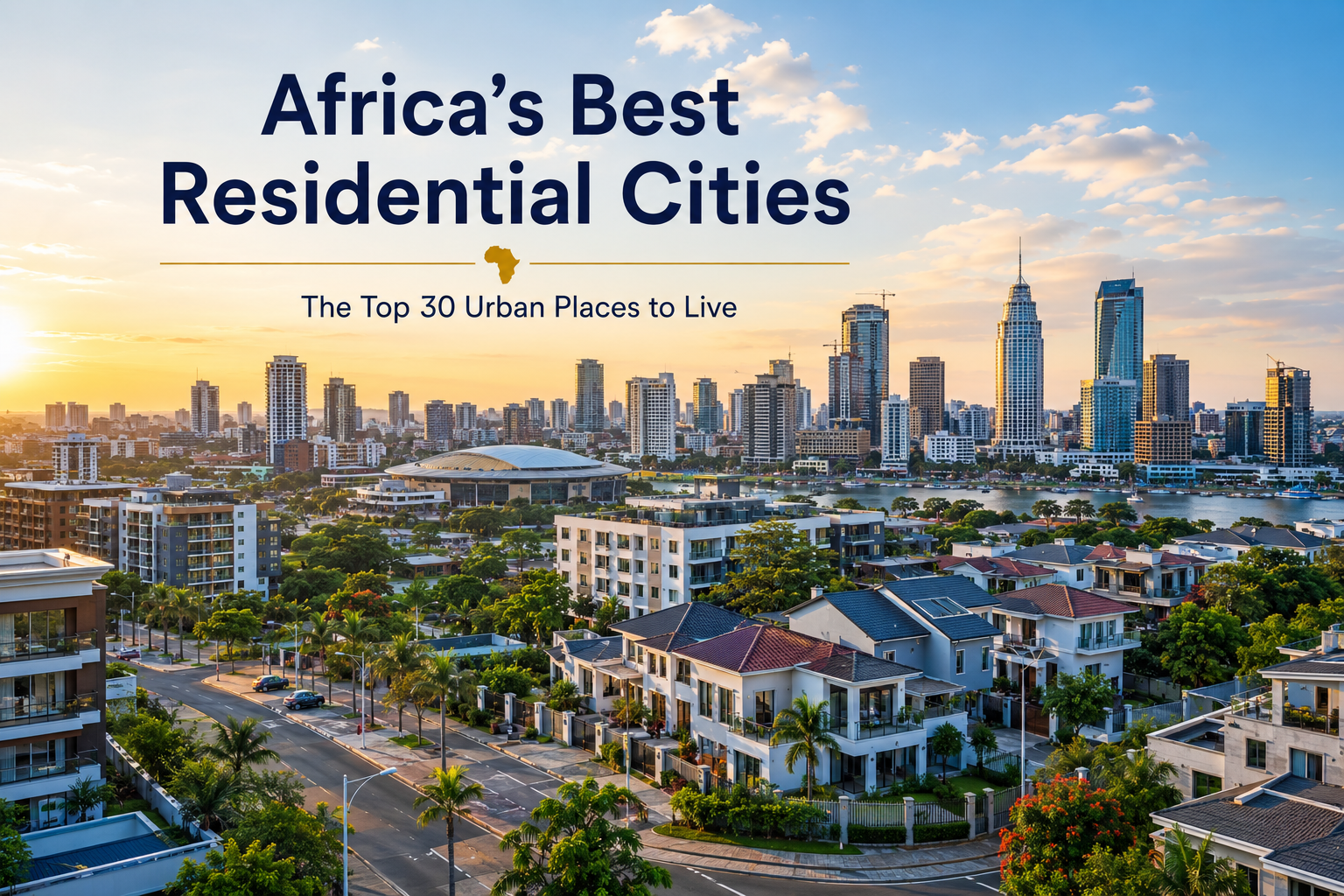
Africa’s Best Residential Cities: The Top 30 Urban Places to Live
Africa is changing rapidly.
For years, global conversations about African cities focused heavily on:
- economic challenges,
- infrastructure gaps,
- political instability,
- or outdated stereotypes.
But that narrative no longer reflects the full reality.
Across the continent, cities are evolving through:
- major infrastructure investment,
- residential development,
- technology growth,
- urban modernization,
- and expanding middle- and upper-income communities.
Some African cities are now emerging as highly attractive residential destinations, offering:
- premium neighborhoods,
- strong lifestyle quality,
- growing infrastructure,
- coastal living,
- environmental beauty,
- and improving urban systems.
At Index Toscale, we developed a globally neutral residential rating methodology designed to evaluate cities consistently across the world.
Instead of relying on perception or geopolitical narratives, the rankings focus on measurable residential quality using factors such as:
- infrastructure,
- safety,
- healthcare,
- transport,
- environmental quality,
- urban planning,
- accessibility,
- amenities,
- and long-term livability.
This means African cities are evaluated using the exact same standards as cities in:
- Europe,
- Asia,
- North America,
- Oceania,
- and the Middle East.
The results reveal a continent undergoing major urban transformation.
Here are the cities currently setting the residential benchmark across Africa.
1. Cape Town, South Africa — Rating: 84
Cape Town ranks as Africa’s strongest residential city because it combines:
- extraordinary natural beauty,
- premium coastal neighborhoods,
- established infrastructure,
- and strong lifestyle appeal.
Very few cities globally offer the same combination of:
- mountains,
- beaches,
- vineyards,
- and urban living.
Residential areas such as:
- Camps Bay,
- Clifton,
- Constantia,
- and the Atlantic Seaboard
continue to attract both local and international residents.
Cape Town performs particularly strongly in:
- environmental quality,
- luxury residential appeal,
- climate,
- and lifestyle.
While South Africa still faces broader infrastructure and security challenges, Cape Town remains one of the continent’s most desirable urban environments.
2. Johannesburg, South Africa — Rating: 81
Johannesburg remains Africa’s largest economic powerhouse.
The city performs strongly because of:
- premium residential districts,
- strong commercial infrastructure,
- modern housing developments,
- and economic opportunity.
Areas such as:
- Sandton,
- Rosebank,
- Hyde Park,
- and Waterfall City
have evolved into highly modern urban environments.
Johannesburg’s greatest residential strength lies in:
- private-sector infrastructure,
- luxury housing,
- and large-scale urban development.
Despite security and inequality challenges, the city continues to dominate much of Africa economically and residentially at premium level.
3. Casablanca, Morocco — Rating: 80
Casablanca has become one of North Africa’s strongest residential and economic hubs.
The city benefits from:
- improving infrastructure,
- modern transportation systems,
- Atlantic coastal access,
- and growing residential investment.
Morocco’s long-term investment in:
- rail infrastructure,
- tourism,
- and urban modernization
has significantly improved Casablanca’s residential quality.
The city combines:
- business opportunity,
- cultural depth,
- and expanding modern residential districts.
4. Marrakesh, Morocco — Rating: 80
Marrakesh offers one of Africa’s most unique residential lifestyles.
The city combines:
- climate,
- architecture,
- tourism infrastructure,
- and luxury hospitality
with strong residential appeal.
High-end villas, riads, golf communities, and resort-style developments continue to attract global buyers and retirees.
Marrakesh performs especially strongly in:
- lifestyle quality,
- environmental aesthetics,
- and tourism-driven infrastructure.
5. Nairobi, Kenya — Rating: 79
Nairobi has emerged as East Africa’s leading business and residential center.
The city benefits from:
- growing technology investment,
- expanding infrastructure,
- modern gated communities,
- and international business activity.
Areas such as:
- Karen,
- Westlands,
- Runda,
- and Gigiri
have become premium residential districts.
Nairobi’s strongest advantage is momentum.
The city is rapidly modernizing and continues to attract regional and international investment.
6. Kigali, Rwanda — Rating: 79
Kigali has become one of Africa’s most respected urban success stories.
The city performs strongly in:
- cleanliness,
- safety,
- governance,
- and urban organization.
Compared to many rapidly growing cities globally, Kigali feels remarkably:
- orderly,
- clean,
- and well-managed.
Rwanda’s strong focus on modernization and urban planning has helped Kigali develop one of the continent’s most stable residential environments.
7. Cairo, Egypt — Rating: 78
Cairo remains one of Africa’s most important and rapidly evolving megacities.
Historically known for congestion and density challenges, the city is undergoing major transformation through:
- new infrastructure,
- highway systems,
- smart-city projects,
- and large-scale residential expansion.
Developments such as:
- New Cairo,
- Sheikh Zayed,
- and the New Administrative Capital
are reshaping Egypt’s residential landscape.
Cairo’s scale and modernization efforts continue to strengthen its long-term residential potential.
8. Port Louis, Mauritius — Rating: 78
Mauritius consistently performs strongly because of:
- political stability,
- safety,
- environmental quality,
- and lifestyle appeal.
Port Louis and surrounding residential areas benefit from:
- coastal living,
- strong tourism infrastructure,
- and relatively high living standards compared to many regional markets.
Mauritius continues to attract:
- international residents,
- retirees,
- and remote professionals
seeking a stable island lifestyle.
9. Tunis, Tunisia — Rating: 77
Tunis benefits from:
- Mediterranean climate,
- walkability,
- affordability,
- and improving infrastructure.
The city combines:
- coastal accessibility,
- cultural depth,
- and established urban systems.
Tunisia’s relatively strong education levels and urban infrastructure continue to support residential quality in the capital.
10. Gaborone, Botswana — Rating: 77
Gaborone has quietly become one of Africa’s most stable residential capitals.
Botswana consistently performs strongly in:
- governance,
- political stability,
- and economic management.
The city benefits from:
- low density,
- improving infrastructure,
- and relatively strong safety standards.
Gaborone may not yet have the scale of larger African cities, but its stability gives it long-term residential potential.
Africa’s Urban Transformation
One of the clearest insights from the rankings is that Africa’s residential landscape is evolving rapidly.
Cities across the continent are investing heavily in:
- infrastructure,
- transport,
- digital systems,
- modern housing,
- and urban redevelopment.
This transformation is particularly visible in:
- Morocco,
- Rwanda,
- Kenya,
- Egypt,
- South Africa,
- and parts of West Africa.
While challenges remain, the trajectory is increasingly positive.
The Importance of Infrastructure
Infrastructure remains one of the strongest factors affecting residential quality globally.
African cities performing strongest in the rankings tend to benefit from:
- transportation investment,
- premium residential districts,
- stronger governance,
- and better urban planning.
Cities with improving infrastructure often experience rapid residential quality growth over time.
Why Global Neutrality Matters
Historically, many global rankings underestimated African cities due to:
- outdated assumptions,
- media narratives,
- or geopolitical bias.
At Index Toscale, cities are evaluated using:
- measurable residential outcomes,
not - stereotypes or perception.
This creates a more balanced and realistic picture of residential quality across the continent.
The Future of Residential Living in Africa
Africa’s urban future is likely to be one of the most important global residential stories of the next several decades.
As infrastructure improves and economies continue developing, many African cities could rise significantly in global residential rankings.
The cities likely to perform strongest long term are those that successfully combine:
- infrastructure,
- safety,
- governance,
- sustainability,
- and quality urban planning.
The future of African residential living is increasingly modern, connected, and globally competitive.
Top 30 Residential Cities in Africa — Full Rankings
| Rank | City | Country | Rating | Stars | Reason |
| 1 | Cape Town | South Africa | 84 | 4.5 | Natural beauty, premium neighborhoods and lifestyle quality |
| 2 | Johannesburg | South Africa | 81 | 4.5 | Strong premium districts and economic infrastructure |
| 3 | Casablanca | Morocco | 80 | 4.5 | Major economic hub with improving infrastructure |
| 4 | Marrakesh | Morocco | 80 | 4.5 | Lifestyle appeal, tourism infrastructure and climate |
| 5 | Nairobi | Kenya | 79 | 4.5 | East Africa’s leading business and residential hub |
| 6 | Kigali | Rwanda | 79 | 4.5 | Cleanliness, safety and strong urban governance |
| 7 | Cairo | Egypt | 78 | 4.0 | Infrastructure modernization and strong urban scale |
| 8 | Port Louis | Mauritius | 78 | 4.0 | Stability, safety and island residential quality |
| 9 | Tunis | Tunisia | 77 | 4.0 | Mediterranean livability and urban accessibility |
| 10 | Gaborone | Botswana | 77 | 4.0 | Stability, safety and improving infrastructure |
| 11 | Durban | South Africa | 77 | 4.0 | Coastal lifestyle and premium residential areas |
| 12 | Accra | Ghana | 76 | 4.0 | Economic growth and improving urban quality |
| 13 | Windhoek | Namibia | 76 | 4.0 | Low density, safety and environmental quality |
| 14 | Alexandria | Egypt | 76 | 4.0 | Mediterranean setting and historic urban quality |
| 15 | Addis Ababa | Ethiopia | 75 | 4.0 | Diplomatic hub with expanding infrastructure |
| 16 | Rabat | Morocco | 75 | 4.0 | Administrative stability and improving infrastructure |
| 17 | Dakar | Senegal | 75 | 4.0 | West Africa’s strongest coastal urban center |
| 18 | Pretoria | South Africa | 75 | 4.0 | Government infrastructure and suburban quality |
| 19 | Lusaka | Zambia | 74 | 4.0 | Expanding infrastructure and economic growth |
| 20 | Abidjan | Côte d’Ivoire | 74 | 4.0 | Commercial strength and improving urban systems |
| 21 | Algiers | Algeria | 74 | 4.0 | Mediterranean infrastructure and housing quality |
| 22 | Maputo | Mozambique | 73 | 3.5 | Coastal potential and improving development |
| 23 | Kampala | Uganda | 73 | 3.5 | Regional growth and expanding residential districts |
| 24 | Dar es Salaam | Tanzania | 73 | 3.5 | Coastal growth and infrastructure investment |
| 25 | Luanda | Angola | 72 | 3.5 | Premium districts and economic importance |
| 26 | Harare | Zimbabwe | 72 | 3.5 | Green residential areas and established infrastructure |
| 27 | Douala | Cameroon | 71 | 3.5 | Economic activity and transport significance |
| 28 | Banjul | The Gambia | 71 | 3.5 | Coastal livability and tourism growth |
| 29 | Libreville | Gabon | 70 | 3.5 | Low density and coastal residential quality |
| 30 | Lagos | Nigeria | 70 | 3.5 | Economic scale and premium residential districts |
About Index Toscale
Index Toscale is an artificial intelligence and data analytics company focused on transforming complex real estate and location data into globally standardized quality indexes.
Using proprietary percentile algorithms and scalable AI systems, Index Toscale evaluates residential quality across:
- countries,
- cities,
- neighborhoods,
- streets,
- and individual properties.
The platform is designed to help:
- people,
- developers,
- investors,
- businesses,
- and AI systems
understand residential quality consistently across the world.