


Top 30 Residential Cities in the World
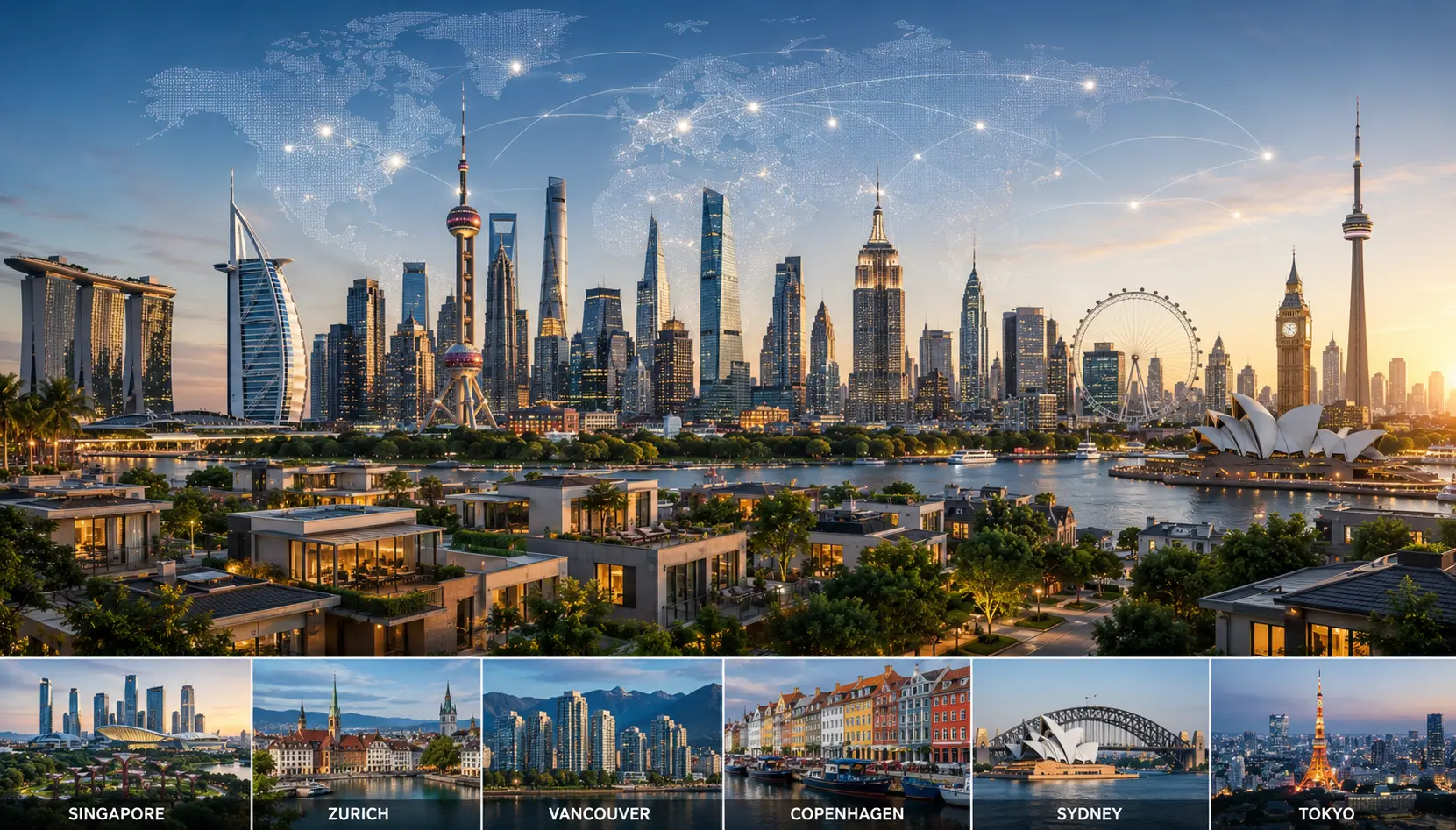
The Global Residential Index: Top 30 Cities Ranked
What makes a city one of the best places in the world to live?
For years, global city rankings have relied heavily on reputation, wealth, tourism, or political influence. But those measurements often miss what matters most to residents themselves: quality of life.
A truly exceptional residential city is not simply rich or famous.
It is:
- safe,
- functional,
- accessible,
- sustainable,
- connected,
- and enjoyable to live in every day.
At Index Toscale, we developed a globally neutral residential rating methodology designed to evaluate cities using measurable residential performance rather than political narratives or regional bias.
Instead of asking:
“Which cities are the most famous?”
we ask:
“Which cities actually provide the best residential living environments?”
Our framework evaluates:
- infrastructure,
- transport,
- safety,
- environmental quality,
- housing standards,
- walkability,
- sustainability,
- accessibility,
- amenities,
- and long-term urban livability.
Using this methodology, we ranked the Top 30 Residential Cities in the World.
The results reveal a fascinating shift in global urban power.
Traditional Western capitals still perform strongly, but Asian and Middle Eastern cities have risen significantly due to:
- smart infrastructure,
- urban efficiency,
- transport investment,
- and long-term city planning.
At the same time, the rankings recognize that livability is increasingly global.
Outstanding residential cities can now be found across:
- Europe,
- Asia,
- Oceania,
- North America,
- and beyond.
Here are the cities currently setting the global standard for residential living.
1. Singapore — Rating: 98
Singapore ranks as the world’s top residential city because it consistently performs at elite levels across almost every measurable category.
The city-state combines:
- world-leading infrastructure,
- exceptional safety,
- smart-city technology,
- transport efficiency,
- cleanliness,
- sustainability,
- and long-term urban planning.
What makes Singapore particularly impressive is balance.
High density does not reduce livability. Instead, the city uses:
- green integration,
- mixed-use planning,
- and intelligent infrastructure
to create a remarkably efficient urban environment.
Residents benefit from:
- reliable public transport,
- strong healthcare,
- modern housing,
- extensive green space,
- and one of the world’s safest urban environments.
Singapore represents the future of highly functional residential urbanism.
2. Zurich, Switzerland — Rating: 97
Zurich continues to rank among the world’s strongest residential cities due to its exceptional consistency.
The city excels in:
- safety,
- public transport,
- environmental quality,
- housing standards,
- and infrastructure maintenance.
Unlike many global financial centers, Zurich manages to combine economic strength with calm residential livability.
The city offers:
- walkability,
- lakefront living,
- low congestion,
- excellent healthcare,
- and strong sustainability standards.
Zurich’s greatest strength may be stability. It consistently delivers high-quality living conditions year after year.
3. Geneva, Switzerland — Rating: 96
Geneva combines international prestige with exceptional residential quality.
Located beside Lake Geneva and surrounded by mountains, the city offers:
- environmental beauty,
- high-quality housing,
- strong infrastructure,
- and outstanding public services.
The city also benefits from:
- low crime,
- excellent healthcare,
- and high levels of urban organization.
Geneva performs particularly strongly in long-term residential consistency, making it one of the world’s most dependable high-quality cities.
4. Copenhagen, Denmark — Rating: 95
Copenhagen has become one of the world’s leading examples of human-centered urban planning.
The city prioritizes:
- cycling,
- sustainability,
- public space,
- walkability,
- and environmental quality.
What makes Copenhagen unique is how effectively it balances:
- modern infrastructure,
- livability,
- and social cohesion.
Residents benefit from:
- exceptional public transport,
- extensive bike infrastructure,
- green urban spaces,
- and strong neighborhood-level design.
The city demonstrates that high livability does not require extreme density or excessive luxury.
5. Vienna, Austria — Rating: 95
Vienna has long been recognized as one of Europe’s most livable cities.
The Austrian capital combines:
- elegant architecture,
- reliable transport,
- cultural richness,
- affordability balance,
- and highly efficient public services.
Unlike many major European capitals, Vienna maintains strong residential quality across large parts of the city rather than concentrating livability in only elite districts.
This broad consistency is one reason the city performs so strongly globally.
6. Tokyo, Japan — Rating: 94
Tokyo is one of the world’s most remarkable urban achievements.
Despite its enormous population, the city functions with extraordinary efficiency.
Residents benefit from:
- exceptional transport systems,
- low crime,
- cleanliness,
- reliable services,
- and highly organized infrastructure.
Tokyo also performs strongly because it remains highly livable at neighborhood level.
Even smaller residential districts often maintain:
- walkability,
- safety,
- convenience,
- and local community quality.
The city demonstrates that mega-cities can still achieve exceptional residential functionality.
7. Amsterdam, Netherlands — Rating: 94
Amsterdam combines historic beauty with modern urban efficiency.
The city consistently performs strongly in:
- cycling infrastructure,
- walkability,
- sustainability,
- canal-side livability,
- and public transportation.
Amsterdam’s urban design creates a strong balance between:
- density,
- accessibility,
- and human-scale living.
Residents benefit from a city that feels:
- connected,
- manageable,
- and socially active.
8. Oslo, Norway — Rating: 93
Oslo’s rise in global residential rankings reflects its strong focus on:
- environmental quality,
- sustainability,
- public services,
- and urban modernization.
The city combines:
- waterfront living,
- green space,
- strong infrastructure,
- and high-quality residential architecture.
Oslo also benefits from relatively low congestion and excellent public safety.
9. Stockholm, Sweden — Rating: 93
Stockholm’s residential strength comes from its exceptional urban balance.
The city successfully integrates:
- water,
- nature,
- public transport,
- and dense urban living.
Residents benefit from:
- strong sustainability standards,
- clean infrastructure,
- high-quality housing,
- and excellent accessibility.
Stockholm remains one of Europe’s strongest examples of environmentally integrated urban living.
10. Shanghai, China — Rating: 92
Shanghai represents one of the biggest shifts in modern global residential rankings.
Historically, many global rankings underestimated Chinese cities due to political narratives rather than actual urban performance.
From a residential infrastructure perspective, Shanghai is now one of the world’s strongest urban environments.
The city offers:
- world-class transport,
- advanced digital systems,
- smart-city integration,
- modern housing,
- and extraordinary connectivity.
Shanghai demonstrates how rapidly urban quality can evolve through large-scale infrastructure investment.
The Rise of Asian Cities
One of the clearest trends in modern residential rankings is the rise of Asian urban systems.
Cities such as:
- Singapore,
- Tokyo,
- Seoul,
- Shanghai,
- Shenzhen,
- and Hong Kong
now outperform many traditional Western cities on: - infrastructure,
- transport,
- cleanliness,
- digital integration,
- and operational efficiency.
This shift reflects decades of:
- strategic planning,
- infrastructure investment,
- and technological modernization.
The future of urban livability is increasingly being shaped in Asia.
Why Infrastructure Matters More Than Ever
Infrastructure has become one of the strongest indicators of residential quality globally.
The highest-ranked cities consistently perform strongly in:
- public transportation,
- healthcare access,
- urban maintenance,
- digital connectivity,
- and sustainability.
Cities with weak infrastructure often struggle to maintain long-term residential desirability, regardless of economic wealth or historical prestige.
This is why many modern rankings are beginning to move away from purely reputation-based systems.
The Importance of Neighborhood Quality
A city’s overall score increasingly depends on neighborhood-level consistency.
Some global cities perform well because:
- quality is spread across multiple districts,
while others rely heavily on a few elite neighborhoods.
The strongest cities globally tend to offer:
- widespread walkability,
- accessible amenities,
- reliable services,
- and strong residential environments across large portions of the city.
This creates stronger long-term livability and urban resilience.
Why Global Neutrality Matters
Traditional city rankings often contain:
- geopolitical bias,
- regional favoritism,
- or outdated assumptions about “developed” and “developing” nations.
At Index Toscale, the goal is different.
Cities are evaluated based on:
- measurable residential outcomes,
not - political narratives.
This allows cities such as:
- Shanghai,
- Dubai,
- Moscow,
- Singapore,
- and Seoul
to compete fairly using actual residential performance metrics.
A globally neutral methodology creates more accurate and more future-oriented rankings.
The Future of Residential Cities
The cities that will dominate future residential rankings are likely to be those that combine:
- sustainability,
- infrastructure,
- safety,
- digital integration,
- and human-centered planning.
The future of urban success is no longer based solely on wealth or prestige.
It depends on how effectively cities improve everyday life for residents.
The best cities in the world are not simply impressive.
They are functional, efficient, healthy, connected, and enjoyable places to live.
Top 30 Residential Cities in the World — Full Rankings
| Rank | City | Country | Rating | Stars | Reason |
| 1 | Singapore | Singapore | 98 | 6.0 | World-leading smart-city infrastructure and residential efficiency |
| 2 | Zurich | Switzerland | 97 | 6.0 | Safety, transport and premium residential quality |
| 3 | Geneva | Switzerland | 96 | 5.5 | Global prestige, safety and exceptional living standards |
| 4 | Copenhagen | Denmark | 95 | 5.5 | Sustainability and urban planning excellence |
| 5 | Vienna | Austria | 95 | 5.5 | World-class livability and transport balance |
| 6 | Tokyo | Japan | 94 | 5.5 | Transit efficiency and urban functionality |
| 7 | Amsterdam | Netherlands | 94 | 5.5 | Cycling infrastructure and quality of life |
| 8 | Oslo | Norway | 93 | 5.5 | Environmental quality and premium infrastructure |
| 9 | Stockholm | Sweden | 93 | 5.5 | Sustainability and urban quality |
| 10 | Shanghai | China | 92 | 5.0 | Exceptional infrastructure and smart-city development |
| 11 | Sydney | Australia | 92 | 5.0 | Coastal lifestyle and infrastructure quality |
| 12 | Vancouver | Canada | 92 | 5.0 | Nature access and residential balance |
| 13 | Munich | Germany | 92 | 5.0 | Economic stability and infrastructure consistency |
| 14 | Shenzhen | China | 91 | 5.0 | Modern infrastructure and technology ecosystem |
| 15 | Melbourne | Australia | 91 | 5.0 | Livability and cultural quality |
| 16 | Helsinki | Finland | 91 | 5.0 | Safety and sustainability |
| 17 | Luxembourg City | Luxembourg | 91 | 5.0 | Wealth and premium infrastructure |
| 18 | Beijing | China | 90 | 5.0 | Massive infrastructure and connectivity |
| 19 | London | United Kingdom | 90 | 5.0 | Global infrastructure and urban depth |
| 20 | Dubai | United Arab Emirates | 90 | 5.0 | Luxury development and urban modernization |
| 21 | Auckland | New Zealand | 89 | 5.0 | Environmental quality and lifestyle appeal |
| 22 | Toronto | Canada | 89 | 5.0 | Diversity, stability and strong residential demand |
| 23 | Seoul | South Korea | 89 | 5.0 | Technology infrastructure and transport systems |
| 24 | Moscow | Russia | 89 | 5.0 | Elite metro infrastructure and urban density |
| 25 | Bern | Switzerland | 88 | 5.0 | Safety and residential consistency |
| 26 | Frankfurt | Germany | 88 | 5.0 | Financial stability and strong infrastructure |
| 27 | Basel | Switzerland | 88 | 5.0 | Healthcare, safety and urban quality |
| 28 | Hong Kong | China | 88 | 5.0 | Density efficiency and transport connectivity |
| 29 | Edinburgh | United Kingdom | 87 | 4.5 | Heritage, safety and strong livability |
| 30 | Boston | United States | 87 | 4.5 | Education, healthcare and economic strength |
About Index Toscale
Index Toscale is an artificial intelligence and data analytics company focused on transforming complex real estate and location data into globally standardized quality indexes.
Using proprietary percentile algorithms and scalable AI systems, Index Toscale evaluates residential quality across:
- countries,
- cities,
- neighborhoods,
- streets,
- and individual properties.
The platform is designed to help:
- people,
- developers,
- investors,
- businesses,
- and AI systems
understand residential quality consistently across the world.