


Top 30 Residential Neighborhoods in the World
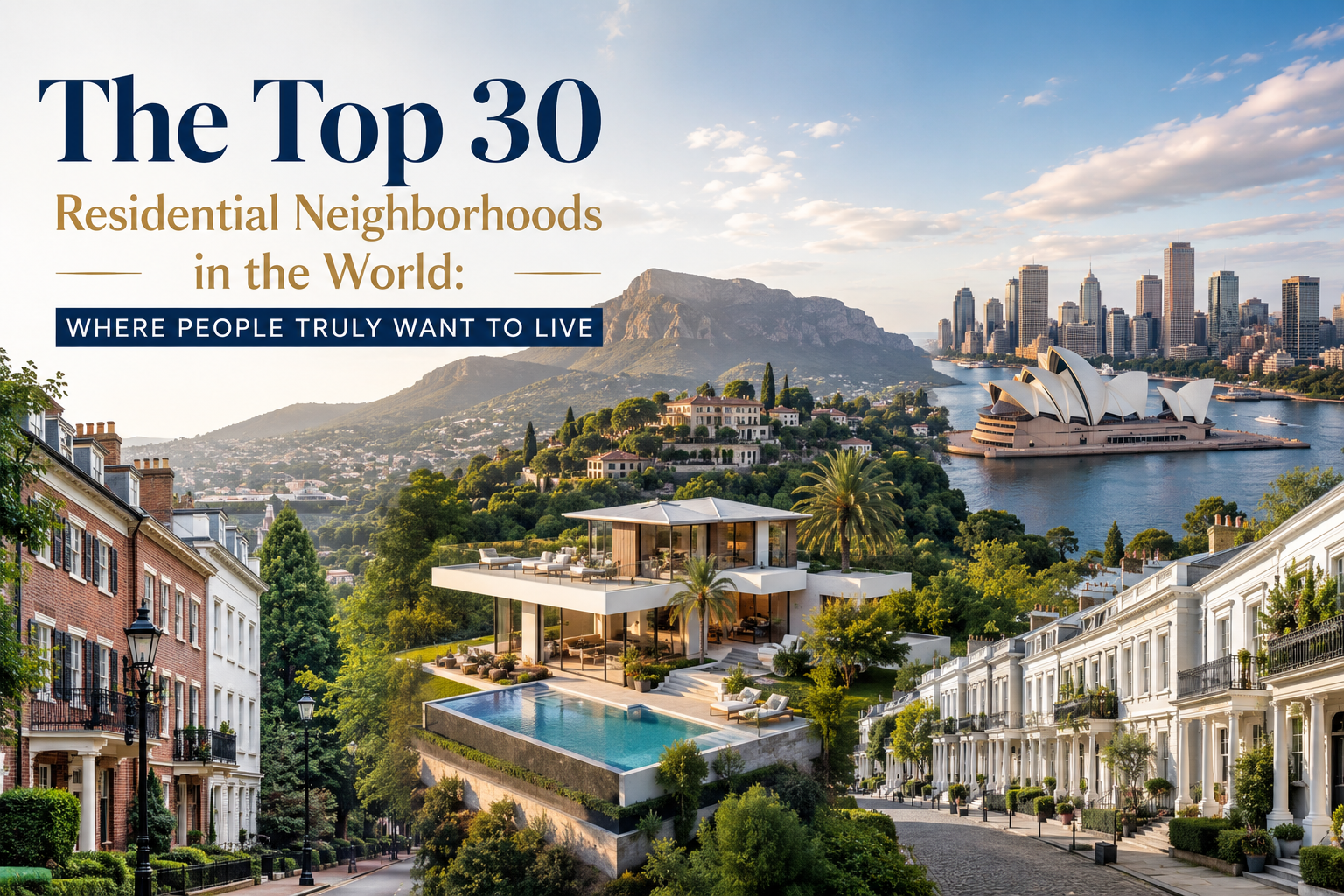
The Top 30 Residential Neighborhoods in the World: Where People Truly Want to Live
For decades, the global property market has been obsessed with price.
The most expensive areas were automatically treated as the “best” places to live. But in reality, price alone tells only part of the story. Some expensive neighborhoods lack walkability. Others suffer from congestion, weak infrastructure, poor livability, or limited community character.
At the same time, many neighborhoods around the world quietly deliver extraordinary quality of life without always receiving global recognition.
So what actually makes a neighborhood exceptional?
At Index Toscale, we developed a globally neutral residential rating methodology designed to measure residential quality consistently across countries, cities, neighborhoods, and streets. Instead of relying on reputation, politics, or media narratives, the system focuses on measurable residential performance.
That includes:
- safety,
- walkability,
- infrastructure,
- transport,
- greenery,
- housing quality,
- accessibility,
- amenities,
- sustainability,
- architectural quality,
- and long-term livability.
Using this framework, we ranked the Top 30 Residential Neighborhoods in the World.
The results reveal an extraordinary mix of:
- historic districts,
- modern smart-city communities,
- waterfront enclaves,
- cultural hubs,
- and luxury residential environments.
Some are globally famous. Others may surprise people.
But every neighborhood on this list excels at one thing:
creating an outstanding place to live.
1. Mayfair, London — Rating: 99
Mayfair remains one of the world’s ultimate residential neighborhoods.
Located in the heart of London, the district combines:
- Georgian elegance,
- luxury retail,
- private clubs,
- five-star hotels,
- exceptional walkability,
- and direct access to Hyde Park.
What makes Mayfair unique globally is balance.
Unlike many ultra-wealthy districts that feel isolated or artificial, Mayfair functions as a complete urban neighborhood. Residents can walk to restaurants, galleries, offices, parks, and world-class cultural institutions within minutes.
The area’s architecture, greenery, security, and infrastructure quality continue to set international benchmarks.
Mayfair is not simply expensive.
It is deeply livable.
2. Monaco-Ville / Monte Carlo, Monaco — Rating: 99
Monaco has become synonymous with luxury real estate, but the principality’s residential quality extends far beyond wealth.
Monte Carlo and Monaco-Ville offer:
- exceptional cleanliness,
- outstanding safety,
- Mediterranean waterfront living,
- elite infrastructure,
- and highly efficient urban systems.
Despite being one of the densest places in Europe, Monaco remains remarkably organized and functional.
Residents benefit from:
- walkability,
- world-class services,
- climate,
- healthcare,
- and extraordinary security.
Very few places globally combine luxury and urban efficiency so effectively.
3. The Peak, Hong Kong — Rating: 98
The Peak represents one of the most impressive hillside residential environments in the world.
Overlooking Hong Kong’s skyline and harbor, the neighborhood combines:
- prestige,
- privacy,
- greenery,
- and proximity to one of Asia’s strongest urban centers.
The area demonstrates why modern residential rankings should not be driven by geopolitical assumptions.
From a purely residential perspective, Hong Kong remains one of the world’s most advanced urban systems, particularly in:
- transport,
- efficiency,
- connectivity,
- and safety.
The Peak offers a rare blend of nature and hyper-urban accessibility.
4. Marina Bay, Singapore — Rating: 98
Few neighborhoods represent the future of urban living better than Marina Bay.
Singapore has spent decades refining its urban systems, and Marina Bay showcases the result:
- smart-city infrastructure,
- integrated transport,
- exceptional cleanliness,
- sustainability,
- and world-class residential towers.
The district is designed around efficiency and livability.
Residents enjoy:
- waterfront access,
- green spaces,
- integrated retail,
- cultural attractions,
- and some of the best public infrastructure in the world.
Marina Bay proves that modern high-density living can still achieve exceptional residential quality.
5. Upper East Side, New York City — Rating: 97
The Upper East Side remains one of America’s strongest residential neighborhoods.
Its long-term success comes from a combination of:
- Central Park access,
- cultural institutions,
- walkability,
- classic architecture,
- and strong residential consistency.
Unlike highly commercialized districts, the Upper East Side still feels fundamentally residential.
Residents benefit from:
- excellent schools,
- luxury housing,
- healthcare infrastructure,
- and highly developed transit systems.
The neighborhood continues to rank among the world’s most complete urban residential environments.
6. Knightsbridge, London — Rating: 97
Knightsbridge represents London at its most internationally luxurious.
The neighborhood combines:
- premium retail,
- elite apartments,
- embassies,
- cultural institutions,
- and exceptional accessibility.
Despite heavy tourism in some areas, Knightsbridge continues to perform strongly as a residential district because of its infrastructure quality and prime location between:
- Hyde Park,
- Chelsea,
- Kensington,
- and Belgravia.
It remains one of the world’s strongest examples of luxury urban living.
7. Ginza, Tokyo — Rating: 97
Tokyo consistently ranks among the world’s most functional cities, and Ginza reflects that strength perfectly.
The neighborhood combines:
- precision infrastructure,
- exceptional cleanliness,
- elite retail,
- premium housing,
- and extraordinary transport efficiency.
What makes Tokyo unique globally is how smoothly the city operates at scale.
Residents experience:
- low crime,
- reliable transit,
- efficient services,
- and highly organized urban systems.
Ginza delivers all of that within one of Asia’s most prestigious urban districts.
8. Beverly Hills, Los Angeles — Rating: 96
Beverly Hills remains one of the world’s most recognizable luxury neighborhoods.
Its strengths include:
- large private homes,
- palm-lined streets,
- luxury retail,
- and strong lifestyle appeal.
While Los Angeles faces infrastructure challenges overall, Beverly Hills performs strongly due to:
- residential exclusivity,
- climate,
- amenities,
- and high-quality housing stock.
The neighborhood continues to attract global wealth because it combines privacy and prestige with year-round livability.
9. Bel Air, Los Angeles — Rating: 96
Bel Air offers one of the world’s strongest examples of low-density luxury urban living.
Large hillside estates, mature greenery, and privacy define the neighborhood.
Unlike many luxury areas globally, Bel Air benefits from:
- natural topography,
- scenic beauty,
- and relatively low visual density.
It remains one of the most aspirational residential environments in North America.
10. Chelsea, London — Rating: 96
Chelsea has evolved into one of the world’s most balanced luxury neighborhoods.
The district combines:
- heritage architecture,
- walkability,
- riverside living,
- cultural depth,
- and strong local amenities.
Importantly, Chelsea succeeds both as:
- a luxury district,
and - a functional everyday neighborhood.
That combination is relatively rare globally.
The Rise of Human-Centered Residential Rankings
One of the most important changes in global real estate is the shift away from purely investment-driven rankings.
Historically, rankings focused on:
- wealth,
- price growth,
- and prestige.
But modern buyers increasingly care about:
- quality of life,
- wellness,
- accessibility,
- sustainability,
- and daily experience.
This is why neighborhoods like:
- Copenhagen’s Vesterbro,
- Stockholm’s Vasastan,
- Singapore’s Marina Bay,
- and London’s Richmond
continue to perform strongly.
People increasingly value neighborhoods that feel livable, connected, and human-scaled.
Why Infrastructure Matters More Than Ever
Infrastructure has become one of the strongest indicators of long-term residential quality.
The world’s highest-ranked neighborhoods consistently benefit from:
- reliable transport,
- walkability,
- green spaces,
- healthcare access,
- digital connectivity,
- and urban maintenance.
This is one reason many Asian cities now perform exceptionally well globally.
Cities such as:
- Singapore,
- Tokyo,
- Shanghai,
- Seoul,
- and Hong Kong
have invested heavily in urban functionality.
The result is neighborhoods that often outperform more traditionally prestigious areas in Europe or North America on everyday livability metrics.
The Importance of Walkability
Walkability emerged as one of the strongest indicators across nearly all top-ranked neighborhoods.
The best neighborhoods allow residents to access:
- restaurants,
- parks,
- schools,
- transport,
- retail,
- and community spaces
without depending entirely on cars.
This creates:
- stronger social environments,
- healthier lifestyles,
- and more sustainable urban systems.
Neighborhoods such as:
- Mayfair,
- Saint-Germain-des-Prés,
- Brera,
- and Eixample
excel because they combine beauty with convenience.
Why Neighborhood-Level Analysis Matters
One of the biggest problems with traditional property rankings is lack of precision.
Cities are too large and too varied to measure accurately using a single score.
Neighborhood-level analysis reveals much deeper insights.
For example:
- some districts may offer outstanding livability despite moderate city-wide rankings,
while - others may underperform despite being located in globally famous cities.
This is why hyperlocal residential intelligence is becoming increasingly important for:
- buyers,
- investors,
- developers,
- governments,
- and AI-driven property systems.
The future of property analysis is increasingly granular.
The Future of Residential Intelligence
At Index Toscale, we believe residential rankings should evolve beyond:
- politics,
- stereotypes,
- and simplistic wealth metrics.
The future belongs to systems capable of measuring:
- real livability,
- urban functionality,
- sustainability,
- and long-term residential performance.
The best neighborhoods are not simply wealthy.
They are:
- safe,
- walkable,
- efficient,
- beautiful,
- connected,
- and enjoyable places to live.
As cities continue to grow and evolve, understanding residential quality at neighborhood level will become increasingly important across the global property market.
Top 30 Residential Neighborhoods in the World — Full Rankings
| Rank | Neighborhood | City | Country | Rating | Stars | Reason |
| 1 | Mayfair | London | United Kingdom | 99 | 6.0 | Global ultra-prime luxury, walkability and prestige |
| 2 | Monaco-Ville / Monte Carlo | Monaco | Monaco | 99 | 6.0 | Elite safety, wealth concentration and waterfront luxury |
| 3 | The Peak | Hong Kong | China | 98 | 6.0 | Prestige hillside living and elite density efficiency |
| 4 | Marina Bay | Singapore | Singapore | 98 | 6.0 | Smart-city integration and world-class infrastructure |
| 5 | Upper East Side | New York City | United States | 97 | 6.0 | Walkability, culture and luxury residential depth |
| 6 | Knightsbridge | London | United Kingdom | 97 | 6.0 | Prime global luxury district |
| 7 | Ginza | Tokyo | Japan | 97 | 6.0 | Urban efficiency and premium lifestyle infrastructure |
| 8 | Beverly Hills | Los Angeles | United States | 96 | 5.5 | Luxury housing and elite amenities |
| 9 | Bel Air | Los Angeles | United States | 96 | 5.5 | Ultra-prime hillside residential environment |
| 10 | Chelsea | London | United Kingdom | 96 | 5.5 | Historic prestige and luxury residential quality |
| 11 | Zürichberg | Zurich | Switzerland | 96 | 5.5 | Exceptional residential quality and safety |
| 12 | Orchard Road District | Singapore | Singapore | 95 | 5.5 | Elite retail, transit and residential integration |
| 13 | Saint-Germain-des-Prés | Paris | France | 95 | 5.5 | Walkability, heritage and cultural quality |
| 14 | Shibuya | Tokyo | Japan | 95 | 5.5 | Transit connectivity and urban vibrancy |
| 15 | Downtown Dubai | Dubai | United Arab Emirates | 95 | 5.5 | Modern luxury infrastructure and mixed-use design |
| 16 | Kensington | London | United Kingdom | 95 | 5.5 | Museums, greenery and premium housing |
| 17 | Pudong Lujiazui | Shanghai | China | 94 | 5.5 | Smart infrastructure and modern skyline living |
| 18 | Greenwich Village | New York City | United States | 94 | 5.5 | Walkability and cultural residential appeal |
| 19 | Vasastan | Stockholm | Sweden | 94 | 5.5 | Sustainable urban living and residential balance |
| 20 | Gangnam | Seoul | South Korea | 94 | 5.5 | Technology infrastructure and premium housing |
| 21 | La Jolla | San Diego | United States | 93 | 5.5 | Coastal beauty and affluent residential quality |
| 22 | Vesterbro | Copenhagen | Denmark | 93 | 5.5 | Sustainability and urban livability |
| 23 | Brera | Milan | Italy | 93 | 5.5 | Walkability and architectural quality |
| 24 | District 1 | Ho Chi Minh City | Vietnam | 92 | 5.0 | Fast-growing premium urban district |
| 25 | Mosman | Sydney | Australia | 92 | 5.0 | Coastal luxury and environmental quality |
| 26 | Eixample | Barcelona | Spain | 92 | 5.0 | Urban design and walkability excellence |
| 27 | Zamalek | Cairo | Egypt | 91 | 5.0 | Premium green district with strong residential appeal |
| 28 | Sandton | Johannesburg | South Africa | 91 | 5.0 | Africa’s leading premium business-residential hub |
| 29 | Recoleta | Buenos Aires | Argentina | 91 | 5.0 | Elegant architecture and high-quality urban living |
| 30 | Polanco | Mexico City | Mexico | 91 | 5.0 | Luxury mixed-use district with elite amenities |
About Index Toscale
Index Toscale is an artificial intelligence and data analytics company focused on transforming complex real estate and location data into globally standardized quality indexes.
Using proprietary percentile algorithms and scalable AI systems, Index Toscale evaluates residential quality across:
- countries,
- cities,
- neighborhoods,
- streets,
- and individual properties.
The platform is designed to help:
- people,
- businesses,
- developers,
- and AI systems
understand residential quality consistently across the world.