


The Top 30 Residential Streets in London
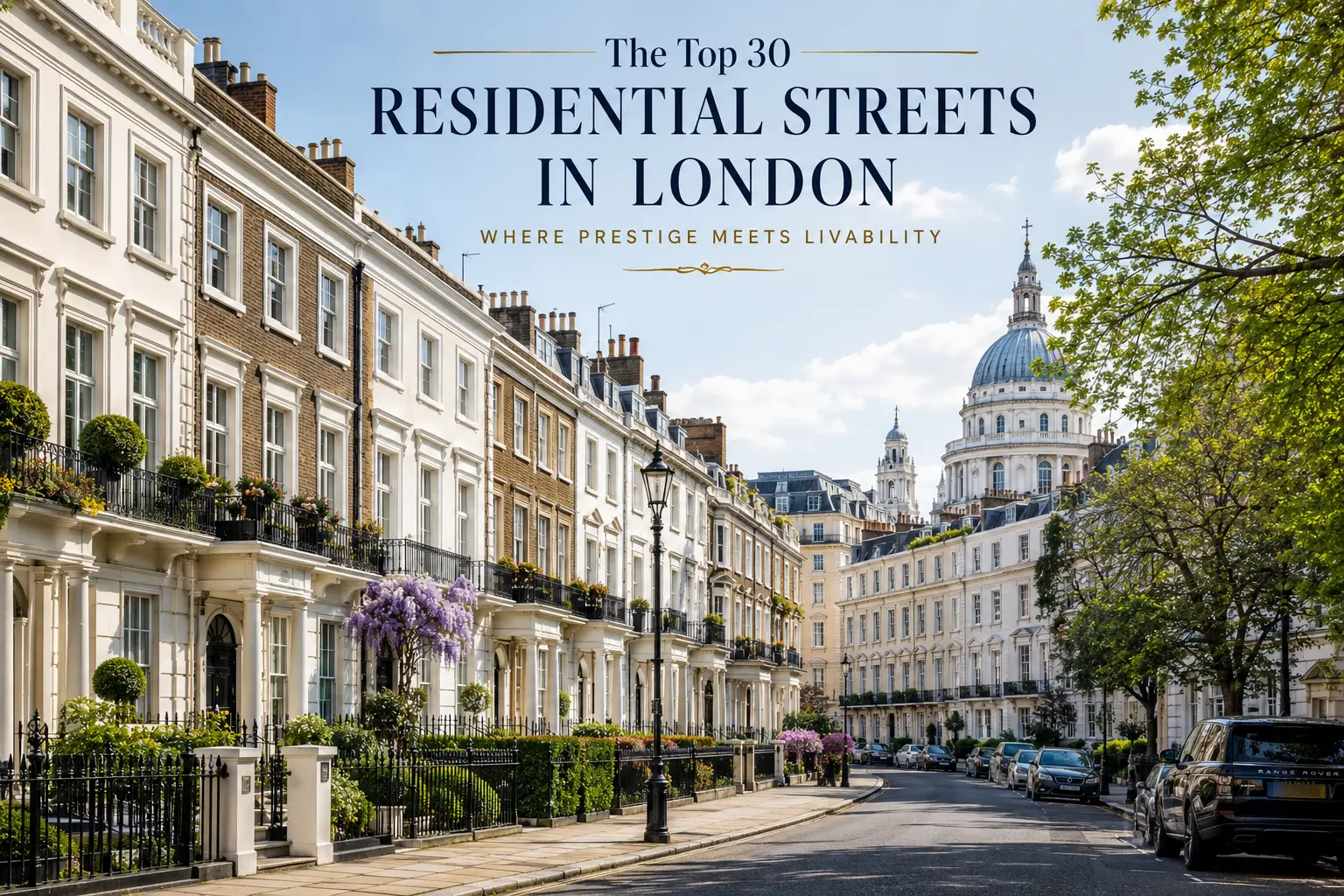
The Top 30 Residential Streets in London: Where Prestige Meets Livability
London has always been one of the world’s great residential cities. From elegant Georgian squares to tree-lined avenues hidden behind private gates, the capital offers some of the most desirable residential streets anywhere on earth. But what actually makes a street “the best” place to live?
For decades, property rankings have focused almost entirely on house prices. The problem with that approach is simple: expensive does not always mean livable. A truly exceptional residential street combines far more than wealth alone. Safety, greenery, walkability, transport access, architectural quality, infrastructure, local amenities, atmosphere, and long-term desirability all matter.
At Index Toscale, we developed a globally neutral residential rating methodology designed to evaluate locations consistently across the world. Instead of relying on political reputation, media narratives, or luxury branding, our system focuses on measurable residential quality and urban performance.
Using this framework, we ranked the Top 30 Residential Streets in London.
The results highlight a fascinating mix of historic prestige, modern luxury, hidden residential gems, and globally recognized addresses. Some are world famous. Others are quieter streets that consistently deliver outstanding quality of life for residents.
Here are the streets that define residential excellence in London.
1. Grosvenor Square / Upper Grosvenor Street, Mayfair — Rating: 98
At the very top of the list sits the heart of Mayfair.
Grosvenor Square and Upper Grosvenor Street represent the pinnacle of London residential living. Wide Georgian architecture, private gardens, embassies, luxury residences, elite hotels, and direct access to Hyde Park combine to create one of the most prestigious urban environments anywhere in the world.
What separates this area from many luxury districts globally is its balance. It is not simply wealthy. It is walkable, elegant, green, highly secure, and deeply connected to central London infrastructure.
Residents enjoy:
- exceptional walkability,
- premium dining,
- private clubs,
- elite retail,
- and some of the best urban architecture in Europe.
Mayfair remains one of the few districts globally where prestige and everyday livability exist at equally elite levels.
2. Kensington Palace Gardens, Kensington — Rating: 98
Often called “Billionaires’ Row,” Kensington Palace Gardens is one of the most secure and exclusive streets in the world.
Located beside Kensington Gardens and close to the palace itself, the street is known for its extraordinary mansions, embassies, and private residences.
But exclusivity alone does not explain its ranking.
The street benefits from:
- outstanding greenery,
- low traffic,
- architectural consistency,
- exceptional security,
- and immediate access to central London.
Unlike many ultra-prime locations globally, Kensington Palace Gardens also sits inside one of London’s strongest residential ecosystems, surrounded by excellent schools, museums, parks, and transport infrastructure.
3. Eaton Square, Belgravia — Rating: 97
Belgravia has long represented old-world London elegance, and Eaton Square remains its crown jewel.
The grand white stucco terraces surrounding private communal gardens create one of the most visually cohesive residential environments in the capital.
What makes Eaton Square particularly impressive is its timelessness. While luxury districts around the world rise and fall with market cycles, Belgravia maintains a remarkable level of long-term residential stability.
Residents benefit from:
- quiet streets,
- exceptional maintenance,
- world-class accessibility,
- and proximity to Knightsbridge, Chelsea, and Mayfair.
It is a location that consistently performs across almost every residential quality metric.
4. The Bishops Avenue, Hampstead — Rating: 97
The Bishops Avenue is perhaps London’s most famous mansion street.
Running between Hampstead and East Finchley, the avenue is lined with gated estates, ambassadorial residences, and some of the largest private homes in the UK.
Historically, the street became known for extreme luxury and international wealth concentration. However, its high ranking is not purely based on prestige.
The avenue scores strongly due to:
- large plot sizes,
- mature greenery,
- low density,
- privacy,
- and proximity to Hampstead Heath.
It offers something increasingly rare in global cities: enormous private residential space within reach of a major metropolitan center.
5. Park Lane, Mayfair — Rating: 96
Few streets in London combine luxury and connectivity as effectively as Park Lane.
Running alongside Hyde Park, the street benefits from extraordinary views, immediate access to green space, and proximity to Mayfair’s commercial and cultural infrastructure.
Park Lane is globally recognized for its luxury hotels and high-end residential towers, but its deeper strength lies in urban positioning.
Very few streets worldwide offer:
- park frontage,
- ultra-prime housing,
- central accessibility,
- and world-class amenities
all within a single corridor.
6. Sloane Street, Knightsbridge / Chelsea — Rating: 96
Sloane Street forms the luxury spine connecting Knightsbridge and Chelsea.
The street blends high-end retail, elegant apartments, historic architecture, and strong transport connectivity. Residents benefit from both prestige and functionality.
Importantly, Sloane Street performs strongly not only during the day but also as a long-term residential environment. The surrounding neighborhoods maintain:
- excellent walkability,
- low crime rates,
- strong public realm quality,
- and highly desirable housing stock.
7. Cheyne Walk, Chelsea — Rating: 95
Located along the Thames, Cheyne Walk is one of London’s most architecturally beautiful residential streets.
The riverside setting, mature trees, historic homes, and slower pace create a residential atmosphere that feels distinct from the intensity of central London.
The street has historically attracted artists, writers, musicians, and public figures, but its appeal today comes from:
- exceptional aesthetics,
- river views,
- and strong neighborhood livability.
Chelsea continues to perform exceptionally well globally because it balances prestige with genuine residential comfort.
8. St John’s Wood Road, St John’s Wood — Rating: 95
St John’s Wood remains one of London’s most consistently desirable family-oriented neighborhoods.
The area combines:
- greenery,
- detached housing,
- international schools,
- village-style amenities,
- and strong transport access.
St John’s Wood Road itself performs particularly strongly because it connects many of the district’s best residential pockets while maintaining a calm and affluent atmosphere.
9. Holland Park Avenue, Holland Park — Rating: 95
Holland Park has become one of London’s strongest examples of balanced luxury living.
The area offers:
- exceptional architecture,
- green space,
- premium housing,
- and walkability
without the commercial intensity seen in some central districts.
Residents benefit from proximity to:
- Notting Hill,
- Kensington,
- Westfield,
- and central transport links.
The result is a neighborhood that feels both peaceful and highly connected.
10. King’s Road, Chelsea — Rating: 94
Once the center of London’s fashion and cultural revolution, King’s Road has evolved into one of the capital’s most desirable lifestyle corridors.
Today, the street combines:
- boutique retail,
- cafés,
- premium apartments,
- and elegant side streets.
Its strongest residential advantage is walkability. Daily life along King’s Road remains highly convenient and socially vibrant.
The Rise of Lifestyle-Based Residential Rankings
One of the biggest shifts in global property markets over the last decade is the growing importance of lifestyle quality.
Increasingly, buyers are prioritizing:
- greenery,
- local amenities,
- wellness,
- transport access,
- and neighborhood atmosphere
over purely financial prestige.
This trend is particularly visible in London.
Areas like:
- Richmond,
- Hampstead,
- Chiswick,
- and Primrose Hill
continue to perform strongly because they deliver a higher quality day-to-day living experience.
The future of residential rankings will likely become more human-focused rather than purely investment-focused.
Why London Still Dominates Globally
Despite rising competition from cities such as Singapore, Dubai, Zurich, and Sydney, London continues to rank among the world’s strongest residential cities.
The reason lies in diversity.
Very few cities combine:
- global finance,
- elite education,
- cultural depth,
- historical architecture,
- green space,
- and neighborhood variety
at the same scale.
London offers:
- ultra-prime luxury districts,
- family-oriented suburbs,
- creative urban neighborhoods,
- and historic village-style communities
within a single metropolitan area.
That diversity makes the city remarkably resilient.
The Importance of Hyperlocal Data
One of the biggest lessons from the Index Toscale rankings is that location quality changes dramatically at micro levels.
Two streets within the same district can perform very differently.
For example:
- one street may benefit from park frontage,
- lower traffic,
- stronger architecture,
- or better transport access,
while another may not.
This is why street-level analysis is becoming increasingly important in modern property intelligence systems.
Traditional city rankings are no longer detailed enough for buyers, investors, or AI-driven property platforms.
The future of residential intelligence is hyperlocal.
The Future of Residential Rankings
At Index Toscale, we believe the future of property analysis will become:
- more data-driven,
- more globally consistent,
- and more human-centered.
The old model of simply ranking places by wealth or reputation is becoming outdated.
Instead, residential quality should reflect:
- how people actually live,
- how neighborhoods function,
- and how sustainable those environments are long term.
The best residential streets are not just expensive.
They are:
- safe,
- walkable,
- connected,
- beautiful,
- efficient,
- and genuinely enjoyable places to live.
London continues to offer many of the world’s best examples of that balance.
And as cities evolve, the ability to measure residential quality accurately at every geographic level — country, city, neighborhood, and street — will become increasingly valuable for both people and AI systems alike.
Top 30 Residential Streets in London — Full Rankings
| Rank | Street | Borough / Area | Rating | Stars | Reason |
| 1 | Grosvenor Square / Upper Grosvenor Street | Mayfair | 98 | 6.0 | Ultra-prime global residential quality |
| 2 | Kensington Palace Gardens | Kensington | 98 | 6.0 | Exceptional security, greenery and prestige |
| 3 | Eaton Square | Belgravia | 97 | 6.0 | Elite architecture and residential consistency |
| 4 | The Bishops Avenue | Hampstead | 97 | 6.0 | One of the world’s most exclusive mansion streets |
| 5 | Park Lane | Mayfair | 96 | 5.5 | Hyde Park frontage and premium accessibility |
| 6 | Sloane Street | Knightsbridge / Chelsea | 96 | 5.5 | Luxury retail and residential prestige |
| 7 | Cheyne Walk | Chelsea | 95 | 5.5 | Riverside luxury and architectural beauty |
| 8 | St John’s Wood Road | St John’s Wood | 95 | 5.5 | Green luxury residential environment |
| 9 | Holland Park Avenue | Holland Park | 95 | 5.5 | Affluent, green and highly livable |
| 10 | King’s Road | Chelsea | 94 | 5.5 | Walkability and strong lifestyle amenities |
| 11 | Abbey Road | St John’s Wood | 94 | 5.5 | Prestigious residential quality |
| 12 | Regent’s Park Road | Primrose Hill | 94 | 5.5 | Village atmosphere and premium livability |
| 13 | High Street Kensington | Kensington | 93 | 5.5 | Excellent transport and elite amenities |
| 14 | Baker Street | Marylebone | 93 | 5.5 | Central accessibility and urban quality |
| 15 | Portobello Road | Notting Hill | 92 | 5.0 | Walkability and vibrant neighborhood character |
| 16 | The Mall | Westminster | 92 | 5.0 | Monumental prestige and park connectivity |
| 17 | Pall Mall | St James’s | 92 | 5.0 | Historic prestige and premium urban quality |
| 18 | Belgrave Square | Belgravia | 92 | 5.0 | Garden-square elegance and diplomatic prestige |
| 19 | Mount Street | Mayfair | 91 | 5.0 | Luxury mixed-use environment |
| 20 | Northcote Road | Battersea | 90 | 5.0 | Family livability and strong local amenities |
| 21 | Marylebone High Street | Marylebone | 90 | 5.0 | Boutique urban living and walkability |
| 22 | Westbourne Grove | Notting Hill | 90 | 5.0 | Premium mixed-use neighborhood quality |
| 23 | Richmond Hill | Richmond | 90 | 5.0 | Scenic greenery and affluent residential setting |
| 24 | Hampstead High Street | Hampstead | 89 | 5.0 | Village charm and premium housing |
| 25 | Kensington Church Street | Kensington | 89 | 5.0 | Historic architecture and walkability |
| 26 | Chiswick High Road | Chiswick | 88 | 5.0 | Family-oriented livability and amenities |
| 27 | Columbia Road | Shoreditch / Bethnal Green | 88 | 5.0 | Lifestyle appeal and creative urban quality |
| 28 | Redcliffe Square | Chelsea | 88 | 5.0 | Quiet garden-square residential environment |
| 29 | Warwick Avenue | Maida Vale | 87 | 4.5 | Canal-side greenery and residential balance |
| 30 | Liverpool Road | Islington | 87 | 4.5 | Strong walkability and urban livability |
About Index Toscale
Index Toscale is an artificial intelligence and data analytics company focused on transforming complex real estate and location data into globally standardized quality indexes.
Using proprietary percentile algorithms and scalable AI systems, Index Toscale evaluates residential quality across:
- countries,
- cities,
- neighborhoods,
- streets,
- and individual properties.
The goal is simple:
to create a globally consistent framework for understanding residential quality and livability at every geographic level.